


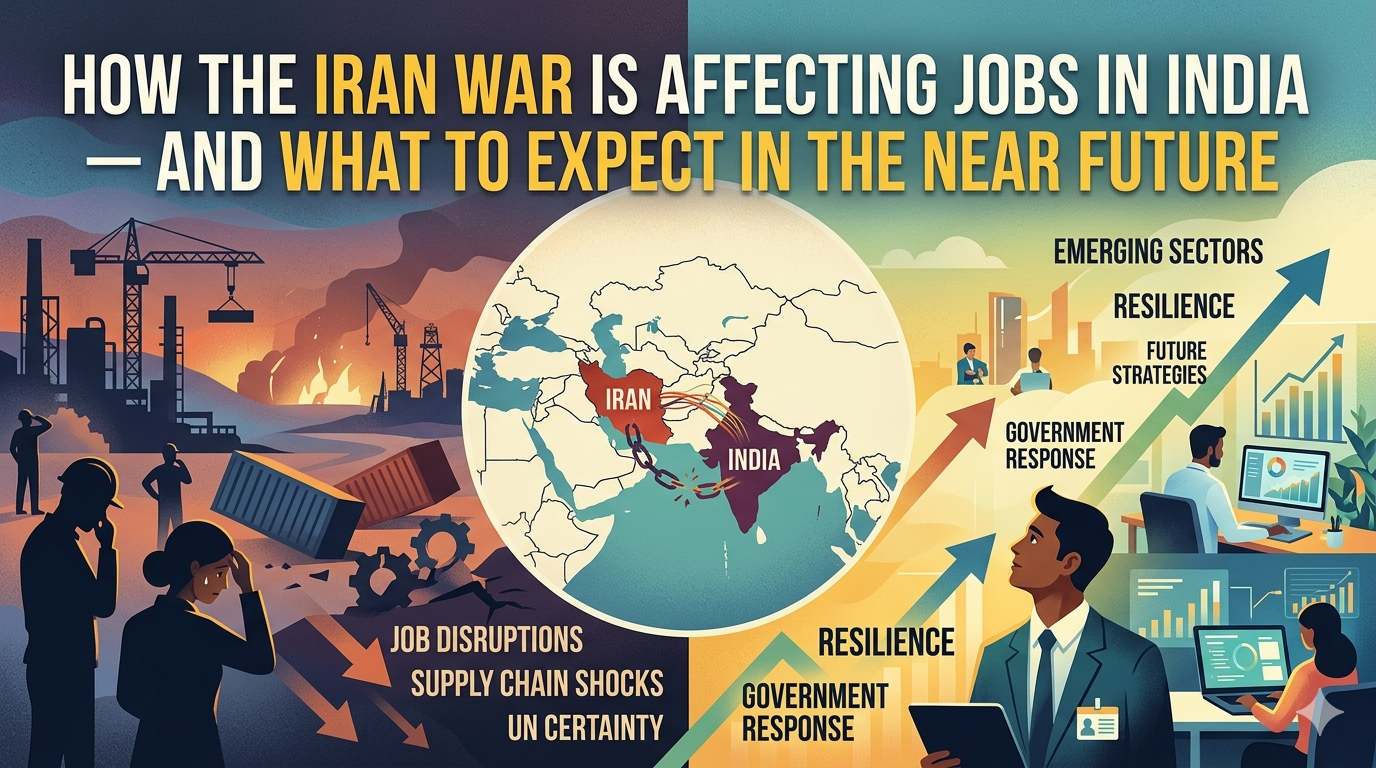
For most Indians, a war happening thousands of kilometers away in the Middle East may initially seem like a distant geopolitical issue. But in today’s interconnected world, conflicts between major oil-producing nations can directly affect household budgets, businesses, salaries, and employment opportunities in India.
The ongoing Iran conflict has already started creating ripple effects across global markets. Oil prices have become unstable, shipping routes are under pressure, inflation fears are growing, and businesses are turning cautious. Since India depends heavily on Middle Eastern oil and also has millions of workers connected to Gulf economies, the impact is impossible to ignore.
The biggest question many Indians are asking now is simple:
Will this affect jobs in India?
The answer is yes — although not every sector will be hit equally. Some industries may slow hiring, some may face layoffs, while others could actually benefit from the situation.
This article breaks down how the Iran war is affecting jobs in India, which sectors are most vulnerable, which industries may grow, and what the near future could look like for Indian workers.
Why the Iran Conflict Matters to India
India imports nearly 85–90% of its crude oil requirements, and a major portion comes through the Gulf region. Any instability involving Iran immediately affects oil supply routes, especially around the Strait of Hormuz — one of the world’s most critical energy shipping lanes.
When oil prices rise globally, everything inside India becomes more expensive:
- Transportation
- Manufacturing
- Electricity
- Logistics
- Airline operations
- Fertilizers
- Food distribution
This creates inflation, and inflation affects businesses. When companies face rising costs and uncertain demand, the first thing they usually slow down is hiring.
That is why global wars often become employment problems in countries far away from the battlefield.
Sectors in India Already Feeling the Pressure
1. Aviation Industry
The aviation sector is among the first industries to feel the impact of rising oil prices because aviation fuel is extremely expensive.
Indian airlines are already dealing with:
- Higher operational costs
- Expensive fuel imports
- Currency pressure due to a weaker rupee
- Rising ticket prices
If the conflict continues, airlines may:
- Reduce expansion plans
- Delay hiring
- Cut costs aggressively
- Freeze salary increments
This could affect:
- Pilots
- Cabin crew
- Ground staff
- Airport contractors
- Travel agencies
Smaller travel companies and tourism startups may especially struggle if international travel demand slows down.
2. Manufacturing and Industrial Jobs
Factories depend heavily on fuel, transport, electricity, chemicals, and imported raw materials.
When oil prices rise:
- Transportation becomes expensive
- Import costs rise
- Production margins shrink
Industries likely to feel pressure include:
- Automobile manufacturing
- Chemicals
- Plastics
- Textiles
- Cement
- Construction materials
Many companies may not immediately fire workers, but they could:
- Delay new recruitment
- Reduce overtime
- Shift to contract hiring
- Slow wage growth
For fresh graduates entering manufacturing sectors, job openings may become more competitive in the coming months.
3. Logistics and Delivery Jobs
India’s logistics sector runs on diesel.
As fuel prices rise:
- Delivery costs increase
- Transport companies face pressure
- E-commerce margins shrink
This impacts:
- Truck drivers
- Warehouse workers
- Delivery partners
- Supply chain executives
Large companies might survive because of scale, but smaller logistics businesses could struggle badly if fuel prices remain high for a long period.
4. IT and Tech Sector
At first glance, IT may not seem directly connected to the Iran conflict. But global uncertainty affects technology spending worldwide.
Many Indian IT companies depend on:
- US clients
- European clients
- Global corporate spending
When geopolitical tensions rise:
- Companies delay projects
- Clients reduce budgets
- Hiring slows
The IT sector is already adjusting to AI-driven restructuring and global economic caution. A prolonged Iran conflict could make companies even more conservative about recruitment.
Freshers may notice:
- Fewer campus placements
- Delayed onboarding
- Increased competition for roles
However, experienced professionals in AI, cybersecurity, cloud computing, and automation may still remain in demand.
5. Gulf Employment Risks for Indians
One of the biggest hidden risks is related to Indians working in Gulf countries.
Millions of Indians work in:
- UAE
- Saudi Arabia
- Qatar
- Kuwait
- Oman
- Bahrain
These workers send billions of dollars back to India every year through remittances.
If the conflict worsens:
- Construction projects may slow
- Hospitality hiring may weaken
- Business confidence may decline
- Indian workers may return home
This creates two major problems:
- Reduced remittance inflows
- Increased job pressure inside India
States like Kerala, Telangana, Andhra Pradesh, and parts of North India that depend heavily on Gulf remittances could feel the impact strongly.
Why Inflation Becomes a Job Problem
Many people think inflation only means expensive petrol and groceries.
But inflation also affects employment.
Here’s how:
When fuel prices rise:
→ Transport costs rise
→ Product prices rise
→ Consumers spend less
→ Business profits fall
→ Companies reduce hiring
This cycle affects almost every industry.
Even sectors that are not directly connected to oil eventually face pressure because overall consumer demand weakens.
For example:
- Restaurants see fewer customers
- Retail stores sell less
- Real estate slows down
- Small businesses struggle
And when businesses become uncertain, they stop expanding.
Which Sectors Could Actually Benefit?
Not all industries lose during geopolitical conflicts. Some sectors may actually grow.
1. Defense and Manufacturing
India is increasing focus on domestic defense production and strategic manufacturing.
Companies involved in:
- Defense equipment
- Surveillance systems
- Aerospace manufacturing
- Cybersecurity
could see increased opportunities.
Government spending on security and infrastructure may create specialized jobs in these sectors.
2. Renewable Energy
The Iran conflict has reminded countries how risky oil dependence can be.
This may accelerate investment in:
- Solar energy
- Electric vehicles
- Battery technology
- Green hydrogen
India is already pushing renewable energy aggressively, and high oil prices could speed up this transition.
This could create jobs in:
- Solar installation
- EV manufacturing
- Energy storage
- Clean-tech startups
3. Agriculture and Local Manufacturing
As global supply chains become uncertain, India may focus more on domestic production.
This can help:
- Local manufacturers
- Food processing companies
- Rural industries
Government support for self-reliance may create medium-term employment opportunities.
What Young Professionals Should Expect
The next 6–12 months could become more competitive for job seekers.
That doesn’t mean a collapse is coming, but hiring patterns may change.
Likely Trends
Slower Hiring
Companies may recruit cautiously until global conditions stabilize.
More Contract Roles
Businesses may prefer temporary workers over permanent employees.
Skills Will Matter More
Companies may prioritize skilled professionals over mass hiring.
Salary Growth Could Slow
Especially in industries affected by fuel and import costs.
Government Hiring May Stay Stable
Public sector recruitment may continue relatively normally compared to private companies.
What Could Happen If the Conflict Gets Worse?
If tensions escalate significantly, India could face:
- Higher inflation
- Slower GDP growth
- Rupee depreciation
- Increased unemployment pressure
- Reduced foreign investment
Economists have already warned that sustained high oil prices could affect India’s economic growth projections.
A major concern is the Strait of Hormuz. If shipping disruptions intensify there, oil prices could rise sharply again, increasing pressure on businesses and consumers globally.
But There Is Another Side to the Story
India today is much stronger economically than it was during earlier global oil crises.
The country has:
- Better foreign exchange reserves
- Diversified energy partnerships
- Strong domestic consumption
- Growing digital economy
- Expanding manufacturing capabilities
This gives India some cushion against external shocks.
Also, global markets usually adapt over time. Even during major geopolitical conflicts, businesses eventually find alternative supply chains, governments intervene, and economies stabilize.
So while the Iran conflict creates short-term uncertainty, it does not automatically mean a long-term economic disaster for India.
What Indian Workers Can Do Right Now
Instead of panicking, professionals should focus on adaptability.
Upskill Aggressively
Skills related to:
- AI
- Automation
- Data analytics
- Cybersecurity
- Renewable energy
- Supply chain management
will likely stay valuable.
Avoid High-Risk Financial Decisions
During uncertain times:
- Avoid unnecessary debt
- Build emergency savings
- Be cautious with speculative investments
Focus on Stable Industries
Healthcare, education, government services, utilities, and essential consumer sectors usually remain more stable during global crises.
Stay Updated
Geopolitical events now directly affect jobs, salaries, investments, and businesses. Staying informed helps professionals make smarter career decisions.
Final Thoughts
The Iran war is not just a foreign policy story anymore. It is slowly becoming an economic story for India — and employment is one of the biggest areas where the effects may be felt.
Rising oil prices, inflation, supply chain disruptions, and uncertainty in global markets are already influencing business decisions. Some industries may slow hiring, some may face pressure, and overseas employment in Gulf countries could become less stable if tensions continue.
At the same time, India’s economy is not powerless. New opportunities may emerge in renewable energy, defense manufacturing, digital infrastructure, and domestic production.
For Indian workers, the near future may demand more flexibility, stronger skills, and smarter financial planning.
History shows that economies recover, industries evolve, and job markets adapt. The people who prepare early are usually the ones who come out stronger when uncertainty eventually settles.
In the coming months, the real challenge for India will not just be managing inflation or fuel prices — it will be protecting employment, supporting businesses, and helping workers transition into the industries that will define the next phase of economic growth.
Employers can post jobs for free on www.refrr.in
India’s best job board which is absolutely free for employers and employees.


