


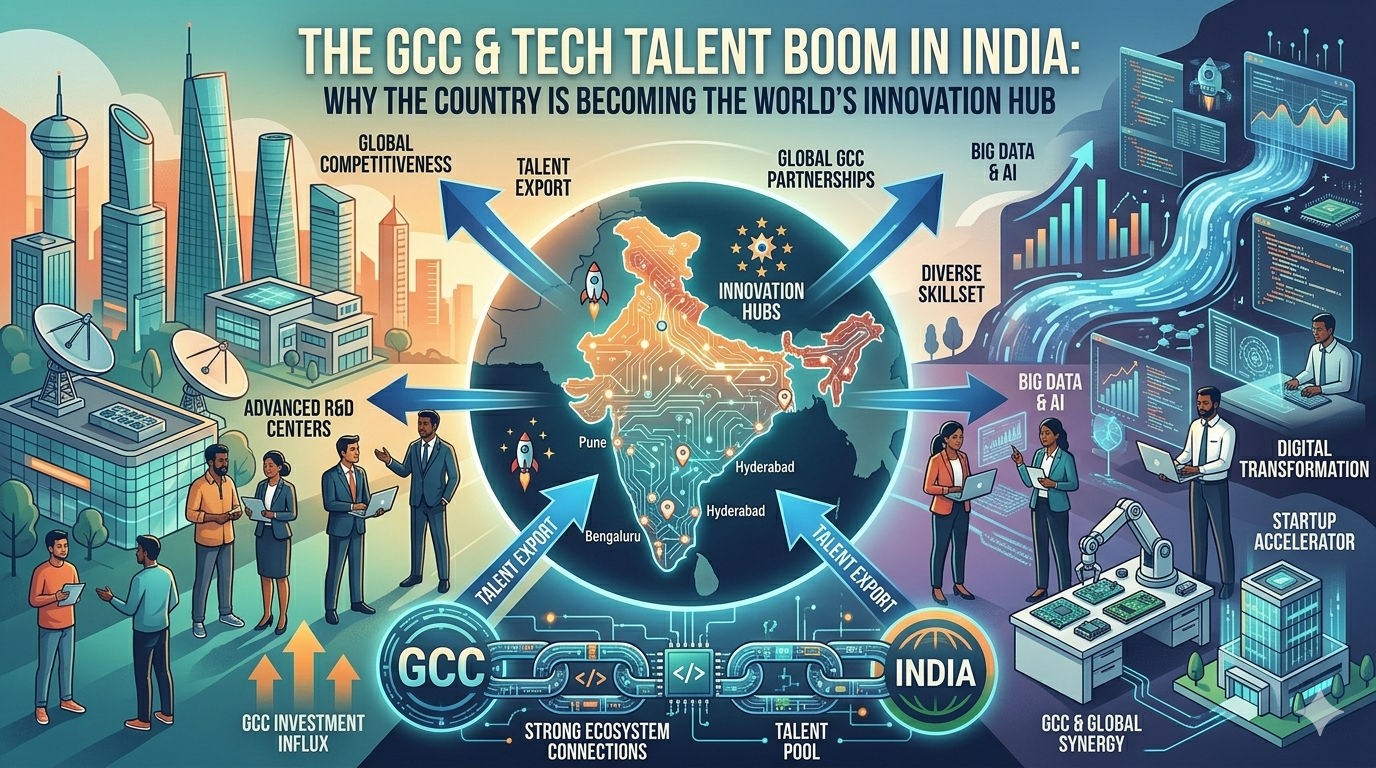
Over the last few years, India’s technology landscape has gone through a major transformation. Earlier, multinational companies looked at India mainly as an outsourcing destination for support services and cost-saving operations. Today, that perception has completely changed.
India is now becoming the global center for innovation, engineering, artificial intelligence, product development, and digital transformation. At the heart of this shift is the explosive rise of GCCs — Global Capability Centers.
From global banks and healthcare giants to retail companies and tech corporations, organizations across the world are rapidly expanding their GCC operations in India. Cities like Bengaluru, Hyderabad, Pune, Chennai, and Gurugram are witnessing an unprecedented hiring boom as companies compete aggressively for skilled technology talent.
For young professionals, engineers, software developers, data analysts, cybersecurity experts, and AI specialists, this is creating one of the biggest career opportunities India has seen in decades.
The rise of GCCs is not just another business trend. It is reshaping India’s economy, job market, salaries, workplace culture, and global reputation.
So what exactly is driving this GCC and tech talent boom in India? Why are global companies investing so heavily here? Which skills are in demand? And what can professionals expect in the future?
Let’s break it down.
What Exactly Is a GCC?
A GCC, or Global Capability Center, is a specialized office established by a multinational company in another country to handle critical business functions.
Earlier, these centers mainly focused on:
- Customer support
- Back-office operations
- Basic IT services
But modern GCCs are very different.
Today, GCCs in India are responsible for:
- Artificial intelligence development
- Cloud engineering
- Cybersecurity
- Product design
- Data science
- Financial analytics
- Automation
- Research and development
- Global innovation projects
In many cases, Indian GCC teams are now building products used worldwide.
This is a massive shift from the old outsourcing model.
India is no longer just “supporting” global businesses. It is helping lead them.
Why India Has Become the GCC Capital of the World
There are several reasons why global companies are choosing India for expansion.
1. Massive Tech Talent Pool
India produces millions of graduates every year, including a huge number of engineers and IT professionals.
While not every graduate is industry-ready immediately, the sheer size of the talent pool gives companies access to:
- Software developers
- AI engineers
- Cloud architects
- Data analysts
- DevOps specialists
- Product managers
- Cybersecurity professionals
No other country currently offers technology talent at this scale.
This is one of the biggest reasons why companies continue investing heavily in India.
2. Cost Advantage — But That’s Not the Main Reason Anymore
A decade ago, companies primarily came to India because labor costs were cheaper.
Today, cost is still important — but it is no longer the biggest factor.
Global companies now realize that Indian professionals are capable of handling:
- Complex engineering
- High-level innovation
- Product ownership
- Leadership roles
- Strategic business functions
Many Indian teams are now leading global projects instead of simply executing instructions from headquarters.
That’s a huge evolution.
3. Strong Startup Ecosystem
India’s startup ecosystem has matured rapidly.
Thousands of startups across:
- Fintech
- SaaS
- AI
- EdTech
- HealthTech
- E-commerce
have created a highly competitive and skilled workforce.
Professionals moving between startups and GCCs bring:
- Agility
- Innovation mindset
- Fast execution
- Product thinking
This startup culture has made Indian talent even more attractive globally.
4. Remote Work Changed Everything
The pandemic completely changed how global companies think about work.
Organizations realized:
- Teams can operate remotely
- Talent can be distributed globally
- Innovation does not need to happen only in Silicon Valley or London
As a result, companies accelerated investments in India.
Many organizations that initially opened small offices in India are now building massive technology hubs here.
The Cities Leading India’s GCC Boom
Bengaluru
Bengaluru remains the undisputed tech capital of India.
It offers:
- Deep engineering talent
- Startup ecosystem
- Venture capital presence
- Experienced professionals
- Strong infrastructure for tech companies
Most major global companies already have large engineering centers here.
The city continues attracting:
- AI companies
- SaaS firms
- Semiconductor businesses
- Cloud computing organizations
Hyderabad
Hyderabad has emerged as one of the biggest competitors to Bengaluru.
Its advantages include:
- Better infrastructure planning
- Lower operational costs
- Government support
- Growing tech ecosystem
Global giants are rapidly expanding operations here.
The city is especially strong in:
- Cloud technology
- Pharmaceuticals tech
- Data analytics
- Enterprise software
Pune
Pune is becoming increasingly popular because of:
- Strong educational institutions
- Engineering talent
- Better work-life balance
- Lower costs compared to Bengaluru
The city has become a major hub for:
- Automotive technology
- Enterprise IT
- Manufacturing software
- Financial services GCCs
Chennai
Chennai has quietly become one of India’s strongest technology and engineering centers.
It is especially important for:
- Automotive engineering
- Electronics
- SaaS
- Manufacturing tech
- Global banking operations
Gurugram & Noida
North India is also seeing massive GCC growth.
These cities attract:
- Consulting firms
- Fintech companies
- E-commerce businesses
- Cybersecurity operations
- Analytics teams
The NCR region is becoming a powerful technology and business hub.
The Skills Companies Are Hiring Aggressively For
The GCC hiring boom is heavily skill-driven.
Companies are no longer hiring only for generic IT support roles.
The biggest demand today is for specialized talent.
Artificial Intelligence & Machine Learning
AI is currently the hottest hiring area globally.
Companies need professionals who understand:
- Generative AI
- Machine learning
- NLP
- AI automation
- Computer vision
Professionals with AI expertise are commanding premium salaries.
Cloud Computing
As businesses move operations to the cloud, demand for cloud experts has exploded.
Skills in:
- AWS
- Azure
- Google Cloud
- Kubernetes
- DevOps
are highly valuable.
Cybersecurity
Cyber threats are increasing worldwide.
Organizations are investing heavily in:
- Threat detection
- Cloud security
- Ethical hacking
- Security operations centers
- Identity management
Cybersecurity professionals are among the most sought-after hires today.
Data Analytics & Data Science
Data-driven decision-making is now central to every business.
Companies need experts who can:
- Analyze customer behavior
- Build dashboards
- Create predictive models
- Extract business insights
Data professionals remain in extremely high demand.
Product Management
Modern GCCs are not just engineering centers anymore.
Many now own global products entirely from India.
This has increased demand for:
- Product managers
- UX designers
- Business analysts
- Agile leaders
Professionals who combine technical and business understanding are becoming especially valuable.
How Salaries Are Changing
One major impact of the GCC boom is rising salaries.
Competition for skilled tech talent has intensified significantly.
Experienced professionals in areas like:
- AI
- Cloud
- Cybersecurity
- Data engineering
often receive multiple offers simultaneously.
Companies are offering:
- Higher salaries
- Remote work flexibility
- Joining bonuses
- ESOPs
- International exposure
- Faster career growth
This has transformed India’s white-collar job market.
Why Freshers Are Both Excited and Nervous
For fresh graduates, this is both an exciting and challenging time.
On one hand:
- More companies are hiring in India than ever before
- Technology careers remain attractive
- Opportunities are expanding
On the other hand:
- Competition is intense
- Companies want practical skills
- Generic degrees alone are no longer enough
Many students still struggle because the industry now values:
- Real-world projects
- Problem-solving ability
- Communication skills
- AI awareness
- Internship experience
Freshers who continuously upskill are more likely to succeed in this environment.
The Rise of Tier-2 Cities
An interesting trend is the gradual rise of smaller cities.
Companies are beginning to explore:
- Ahmedabad
- Coimbatore
- Indore
- Kochi
- Bhubaneswar
- Jaipur
because:
- Costs are lower
- Talent is expanding
- Remote work enables flexibility
This could significantly decentralize India’s technology growth over the next decade.
Challenges Behind the Boom
Despite the excitement, the GCC boom also comes with challenges.
Talent Shortage
Ironically, even though India has a huge workforce, companies still struggle to find highly skilled professionals.
The biggest shortage exists in:
- AI
- Advanced cloud engineering
- Semiconductor design
- Cybersecurity
- Product leadership
Employee Burnout
Aggressive hiring and high expectations have increased workplace pressure.
Many professionals report:
- Long working hours
- Continuous upskilling pressure
- Stress from rapid technological change
The race to stay relevant can become exhausting.
Skill Gap in Education
Many colleges still teach outdated curriculums.
As a result:
- Students often lack practical exposure
- Companies must spend heavily on training
- Industry-academia gaps remain large
Improving education quality will be critical for sustaining India’s talent advantage.
What the Future Looks Like
The future of India’s GCC ecosystem looks incredibly strong.
Experts believe India may soon become:
- The global AI talent hub
- A major semiconductor design center
- One of the world’s largest innovation ecosystems
Global companies increasingly view India not as a support location but as a strategic growth engine.
Over the next five to ten years, we may see:
- More global leadership roles based in India
- Larger R&D investments
- More billion-dollar startups
- Greater international influence for Indian tech professionals
The country’s digital economy is only getting started.
Will AI Replace Jobs?
This is probably the biggest concern among professionals today.
The answer is complicated.
AI will definitely automate some repetitive jobs.
But at the same time, it is creating entirely new roles.
The professionals who adapt quickly will benefit the most.
Skills likely to remain valuable include:
- Critical thinking
- AI integration
- Creativity
- Problem-solving
- Communication
- Leadership
The future workforce will likely work alongside AI rather than compete directly against it.
What Professionals Should Do Right Now
Keep Learning Constantly
Technology is changing faster than ever.
The people who continue learning will stay ahead.
Focus on:
- AI tools
- Cloud platforms
- Automation
- Data skills
- Business understanding
Build Real Projects
Practical experience matters more than certificates alone.
Employers want to see:
- GitHub portfolios
- Case studies
- Internships
- Freelance work
- Problem-solving ability
Improve Communication Skills
Many professionals underestimate this.
But global companies need people who can:
- Explain ideas clearly
- Collaborate internationally
- Present confidently
Communication is becoming a major differentiator.
Stay Adaptable
The tech industry evolves rapidly.
People who resist change often struggle.
Flexibility and curiosity are now career survival skills.
Final Thoughts
India’s GCC and tech talent boom is one of the biggest economic transformations happening in the country today.
What started as an outsourcing story has evolved into something far bigger — a global innovation movement powered by Indian talent.
Multinational companies are no longer coming to India only to reduce costs. They are coming here to build products, lead innovation, solve complex problems, and shape the future of technology.
For professionals, this creates extraordinary opportunities — but also intense competition.
The next decade will likely belong to people who:
- Learn continuously
- Adapt quickly
- Build specialized skills
- Embrace new technologies
India is entering a phase where it is not just participating in the global tech economy — it is becoming one of its central pillars.
And for millions of young Indians, that could change careers, lifestyles, and economic opportunities in ways previous generations could barely imagine.
Employers can post jobs for free on www.refrr.in
India’s best job board which is absolutely free for employers and employees.


